Selective Serotonin Reuptake Inhibitors Response and the Impact of CYP2C19 Metabolizer Status
DOI:
https://doi.org/10.55627/pmc.002.01.0097Abstract
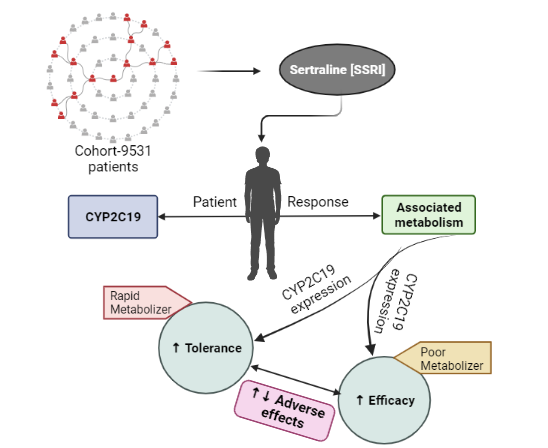
A particular class of antidepressants called selective-serotonin-reuptake-inhibitors (SSRIs) are subjected to altered metabolism as a result of variations in the CYP2C19 gene. Clinicians do take into account the CYP2C19 variations whilst making a pharmacogenomic recommendation. However, the clear links between the efficacy and safety of the drugs to the genetic variations in metabolism are yet to be established. Campos et al, intended to address this question by investigating CYP2C19 polymorphisms and the associated metabolism as well as patient-reported response in a cohort of 9531 patients subjected to SSRIs as part of their regimen. CYP2C19 alleles were the determining factor for metabolizer status. Rapid metabolizers demonstrated higher tolerability but poor metabolizers reported higher efficacy, across all medications. Greater differences were seen in reporting adverse effects for sertraline in various metabolizer groups. The results for tolerability, efficacy and adverse effects, and metabolizer state were in line with previous predictions. Their study did not see slow metabolizers to be at a greater risk for side effects without clinical titration adjustments. Still, both interventional and longitudinal studies such as randomized clinical trials including the whole spectrum of metabolizers are essential to determine the association between CYP2C19 metabolizers and the effects on SSRI treatment efficacy and adverse effects. Pharmacogenomics J. 2022 Mar;22(2):130-135.
Downloads
Published
Issue
Section
License
Copyright (c) 2022 Precision Medicine Communications

This work is licensed under a Creative Commons Attribution 4.0 International License.