Multivariate Analysis of Elite Bt Cotton Genotypes for Seed Cotton Yield and Fiber Quality Traits Under Semi-Arid Conditions
DOI:
https://doi.org/10.55627/pbiotech.003.02.1289Keywords:
Abiotic Stresses, Upland Cotton, Seed Cotton Yield, Fiber quality traits, Multivariate Analysis, Semi-arid conditionsAbstract
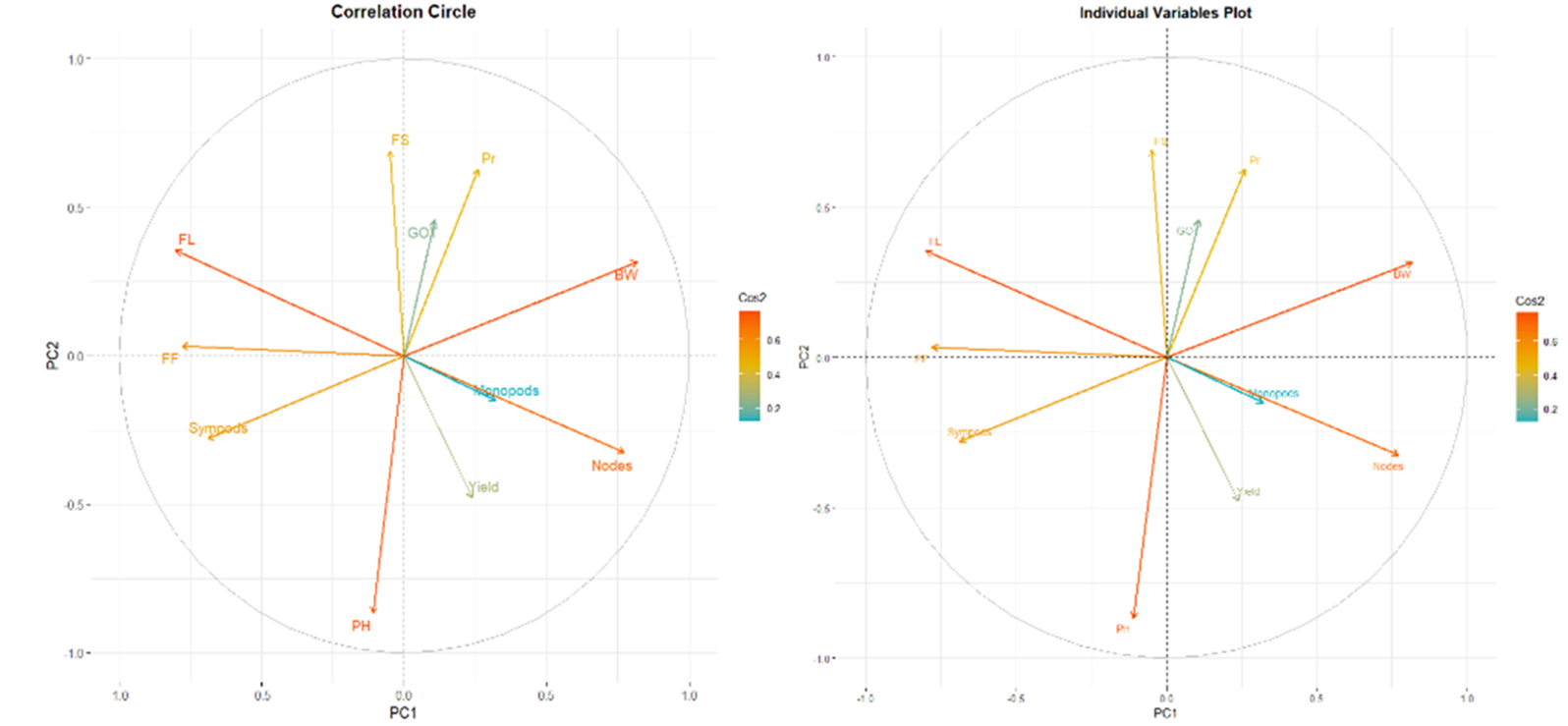
Cotton production in semi-arid regions like Pakistan is constrained by water scarcity and heat stress, resulting in yields significantly lower than global leaders like China. This study evaluated ten elite Bt cotton genotypes (BH-318, BH-348, BH-224, BH-563, BH-405, BH-410, BH-606, BH-248, BH-184, CIM-600) for yield, fiber quality, and associated traits under semi-arid conditions at the Cotton Research Station, Bahawalpur, using a Randomized Complete Block Design with three replications. ANOVA confirmed significant genotypic variation (p ≤ 0.01) for plant height, nodes, sympodial branches, photosynthetic rate, fiber strength, and yield, with BH-348 and BH-224 achieving the maximum yields (2169.1 kg/ha in Cluster 1). Correlation analysis revealed positive associations between yield and nodes (r = 0.741**), plant height (r = 0.548), and sympodial branches (r = 0.416), while PCA showed PC1 (29.4%) and PC2 (22.6%) explaining 52% of the variation, driven by yield and fiber quality traits, respectively. Cluster analysis grouped genotypes into two clusters, with Cluster-1 (BH-318, BH-348, BH-224, BH-606, BH-410, BH-248) excelling in yield and Cluster-2 (BH-563, BH-405, BH-184, CIM-600) in fiber quality (fiber length: 28.9 mm, fiber strength: 35.4 g/tex). The findings from the present multivariate analyses highlight BH-348 and BH-224 as ideal for yield-focused breeding and BH-563 for quality improvement, offering strategies to enhance cotton productivity and quality in semi-arid environments.
References
Downloads
Published
Issue
Section
License
Copyright (c) 2025 Muhammad Younas, Muhammad Zafar, Babar Hussain Babar, Muhammad Jamil, Muhammad Kashif Munir, Muhammad Mahmod Iqbal, Ali Aziz Awan, Sobia Ijaz, Muhammad Tauseef, Abdul Ghaffar Khan, Musarrat Shaheen, Syed Waqar Hussain Shah, Muhammad Irfan Yousaf, Sabir Hussain (Author)

This work is licensed under a Creative Commons Attribution 4.0 International License.