Seed Application of Gamma Radiation in Guar (Cyamopsis tetragonoloba): Boosting Yield and Agronomic Traits through Induced Mutagenesis
DOI:
https://doi.org/10.55627/pbiotech.003.03.1356Keywords:
BR-21 variety, Diversity, Guar, Gamma radiation, Grain yield, Mutagenesis, Plant growthAbstract
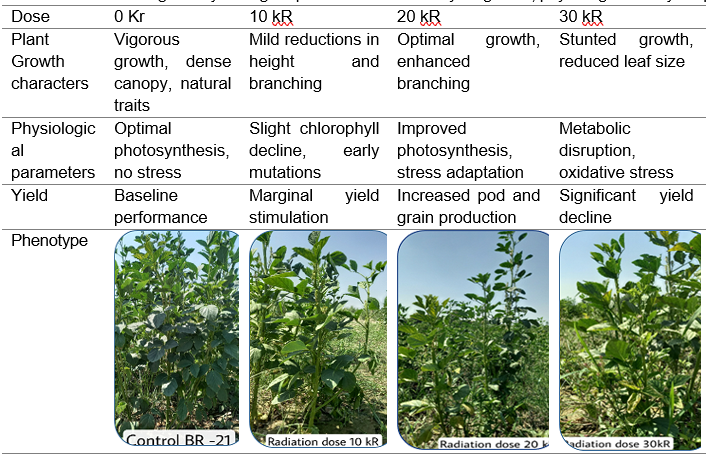
Guar (Cyamopsis tetragonoloba) is a drought tolerant legume crop, plays an important role in agriculture and has versatile uses in different industries. The objective of study was to investigate the effects of gamma radiation on the yield characters of the guar variety “BR-21” because conventional breeding approaches are limited in guar yield improvement due to narrow genetic diversity. For this purpose, seeds of guar variety were treated with different doses (10 to 50 kR) of gamma radiation and agronomic parameters were analyzed in field experiment. From the results it was cleared that low to moderate doses (10–20 kR) increase the yield characters such as clusters per plant, pod length, and grains per pod. Particularly, 20 kR dose proved to be the most efficient dose, greatly enhanced growth and reproductive characters without any adverse effects. Higher doses (30–40 kR), on other hand resulted physiological and genetic damage, growth inhibition, chlorosis, and yield decline. These findings conclude that 20 kR is an effective dose to increase guar yield by creating positive genetic mutations without any adverse effects. The findings from this study provide new insights for mutation breeding programs to enhance crop productivity and also fulfill the demand of guar gum.
References
Downloads
Published
Issue
Section
License
Copyright (c) 2025 Tayyaba Iqbal, Hajra Ibrahim, Muhammad Zubair, Raza Ashraf, Ayesha Sumreen, Muhammad Azhar Zia, Asma Yaqoob, Mashal Rehman, Mahreen Khalid, Madiha Mobeen Khan (Author)

This work is licensed under a Creative Commons Attribution 4.0 International License.