Integrated Application of Biocompost Pressmud and Chemical Fertilizers to Enhance Biomass Production and Nutrient Accumulation of Maize
DOI:
https://doi.org/10.55627/pbiotech.003.03.1400Keywords:
Biocompost pressmud, Biomass production, Fertilizers, Growth, Maize, Nutrient availability, Organic amendmentsAbstract
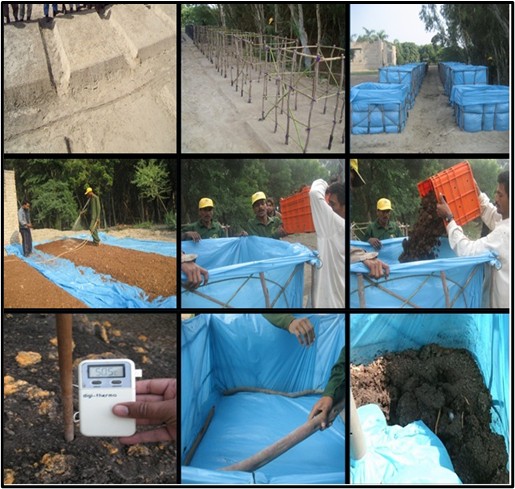
Organic amendments are known to support cost-effective plant nutrition. We assessed the response of maize (Zea mays L.) to varying levels of composted pressmud and chemical fertilizers in a thrice replicated completely randomized factorial experiments, involving different levels of recommended NPK fertilizers (160-80-80 kg ha-1), i.e., control (0%), 25%, 50%, and 100%, and composted press mud, i.e., 0 (control), 10 and 20 t ha-1. The compost was prepared in specially fabricated piles (1m × 1m × 1m), made of 6.0’ long mango sticks. The piles were filled by plastic bins (19”-12”-13”), able to accommodate 17 kg pressmud. The piles were sprayed with the solution of effective microorganisms (EM) and covered with the polythene sheets. A clayey non-saline, alkaline soil was used in this study with low organic matter, phosphorus and potassium content. Ten seeds of maize (cv. Akbar) were planted in pots filled with 10 kg soil, thinned to five, and harvested after seven weeks. Chemical fertilizers and composted press mud significantly improved maize plant traits, except root to shoot ratio, against control treatment. Increased doses increased the performance. When compared to control treatment, the increase was higher in case of using 20 over 10 t ha-1 composted press mud for maize dry biomass (shoot: 29.8 v/s 7.1%, root: 28.9 v/s 5.3%, leaf: 29.2 v/s 8.3%, total: 29.4 v/s 7.0%), leaf area (27.8 v/s 4.9%), and nutrient content (N: 22.2 v/s 11.1%, P: no change, K: 37.5 v/s 25%). Moreover, using 20 t ha-1 composted press mud was more effective than 10 t ha-1 in increasing the dry biomass (shoot: 21.3%, root: 22.5%, leaf: 19.2%, total: 20.9%), leaf area (21.8%), and nutrient content (N: 10%, P: 0%, K: 10%). Using 20 t ha-1 composted press mud with 100% chemical fertilizer recorded maximum increase when compared to the control treatment in maize dry biomass (shoot: 135.1%, root: 132.0%, leaf: 135.5%, total: 137%), leaf area (127.5%), and nutrient content (N: 89.4%, P: 56.8% and K: 82.1%). We conclude that applying 160-80-80 kg NPK with 20 t ha-1 composted pressmud enhances biomass production, leaf area and NPK content of maize.
References
Downloads
Published
Issue
Section
License
Copyright (c) 2025 Zia-ul-hassan Shah, Kazim Raza Suhag, Ghulam Murtaza Jamro, Naheed Akhter Talpur, Hassan Shah Rashdi, Inzamam Ali Jamali, Fozia Naz Memon, Inzamam-ul-Haque Khanzada (Author)

This work is licensed under a Creative Commons Attribution 4.0 International License.