Effect of Organic Potash on Morpho-Physiological Traits, Yield, and Quality of Onion (Allium cepa L.) Cultivars under Field Conditions
DOI:
https://doi.org/10.55627/pbiotech.003.04.1493Keywords:
Bulb Diameter, Bulb yield, Onion (Allium cepa L.), Organic potash, Potassium fertilization, Sustainable nutrient managementAbstract
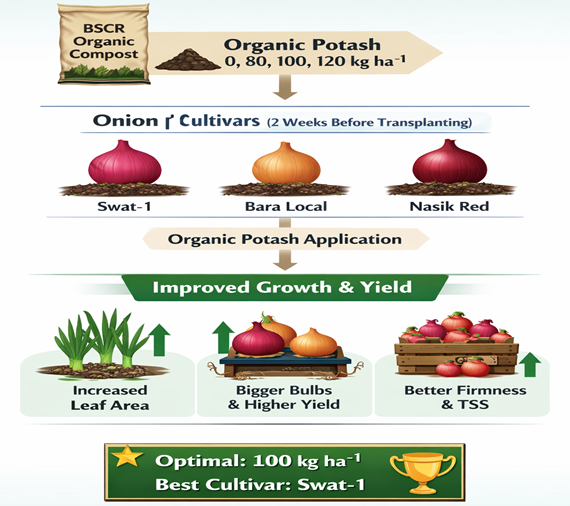
A field experiment was conducted at the University of Agriculture Peshawar (2018) to evaluate the effect of organic potash on the growth, yield, and quality of onion cultivars. The study followed a randomized complete block design with a split-plot arrangement. Organic potash derived from BSCR Organic Compost (Peshawar) was applied at four levels (0, 80, 100, and 120 kg ha⁻¹) two weeks before transplanting, while three onion cultivars (Swat-1, Bara Local, and Nasik Red) were tested. The potassium treatments were controlled with organic potassium being applied as sulphate of potash, but the potash was applied as organic potassium through NKS (4% N, 30% K, and 1% S) two weeks prior to transplanting. The parameters measured were leaf area per plant (cm²), number of leaves per plant, bulb diameter (cm), neck diameter (cm), bulb weight (g), firmness (kg cm⁻²), and bulb yield (t ha⁻¹). The results showed a significant positive effect of organic potash on all measured parameters. The highest plant height (63.92 cm), bulb diameter (6.47 cm), bulb weight (129.47 g), neck diameter (0.87 cm), bulb yield (23.46 t ha⁻¹), and firmness after 180 days of storage (6.3 kg cm⁻²) were observed with 120 kg ha⁻¹ of potash, demonstrating that higher doses improve onion growth and productivity. Results at 100 kg ha⁻¹ were similar, indicating this level is also effective. Among the cultivars, Swat-1 performed best, producing the tallest plants (71.57 cm), the highest number of leaves per plant (11.75), largest leaf area (1206.7 cm²), greatest bulb diameter (6.66 cm), heaviest bulbs (147.76 g), largest neck diameter (0.89 cm), highest bulb yield (23.05 t ha⁻¹), and highest total soluble solids (TSS, 12.01 °Brix). Overall, the graphical abstract highlights that the use of organic potash from a local compost source can sustainably improve onion productivity, with 100 kg ha⁻¹ as the recommended rate and cv. Swat-1 as the most suitable cultivar under Peshawar conditions.
References
Downloads
Published
Issue
Section
License
Copyright (c) 2025 Sadeeq Akbar, Babar Ali, Muhammad Rizwan, Imran Ullah, Muhammad Masoom, Zubair Ahmed Pirzada, Muhammad Sulaiman, Masood Ahmad, Ahmad Sher (Author)

This work is licensed under a Creative Commons Attribution 4.0 International License.