Unraveling Genotypic Stability of Stem Sweetness in Sweet Sorghum across Growth Stages and Environments
DOI:
https://doi.org/10.55627/pbiotech.004.01.1839Keywords:
Sweet sorghum, Stem Brix, Genotype stability, Linear mixed-effects model, BLUP–WAASB analysis, Multi-environment evaluationAbstract
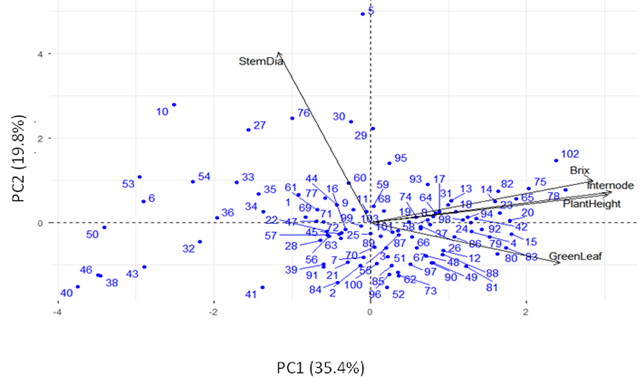
Stem sweetness, that is measured as Brix % is an important trait in sweet sorghum which has direct implication for fodder quality, bioethanol production, and farmer preference. The present study evaluated a diverse panel of 103 sorghum genotypes for stem sweetness in terms of brix% over two consecutive years (2024-2025) at two stages: anthesis and physiological maturity. To address the complexities of environmental variability linear mixed-effects model was used to check the significance of genotype, growth stage, and year along with their interaction effects. The LMM based analysis of variance revealed highly significant effects for genotype, growth stage, and year effect along with their interaction effects. As genotypic effects along with their interactions were significant hence BLUP and WAASB were used to know which genotype is best and more stable. GP-15 and F-902 successfully identified as highly sweet genotypes along with maintaining high brix% regardless of environmental pressure. Furthermore, principal component analysis was exploited that demonstrated a positive correlation of brix% with plant height and internode length, suggesting that sugar storage capacity is linked to vigorous vegetative development. Notably, brix was found to be independent of stem diameter. While checking growth effect brix median progressively increased from ~ 10% to ~ 17% from anthesis to maturity respectively. Further, a potential influence of soil properties on stem Brix expression was also observed. As higher soil nutrients’, OM, P, K availability coincides with increase brix (17%) as compared to low soil nutrients where brix remained 15%. Collectively, these results provide a robust, statistically validated framework for the selection of stable, high-sugar sweet sorghum genotypes optimized for high-quality fodder production in variable rainfed agro-ecologies.
References
Downloads
Additional Files
Published
Issue
Section
License
Copyright (c) 2026 Muhammad Imran Khan, Saba Aleem, Muhammad Zeeshan, Waheed Arshad, Muhammad Saqib, Ayesha Malik, Ghulam Ahmad, Suleman Raza (Author)

This work is licensed under a Creative Commons Attribution 4.0 International License.