Treprostinil Dose in Pulmonary Arterial Hypertension and the Role of Two Polymorphic Genetic Loci
DOI:
https://doi.org/10.55627/pmc.002.01.0096Abstract
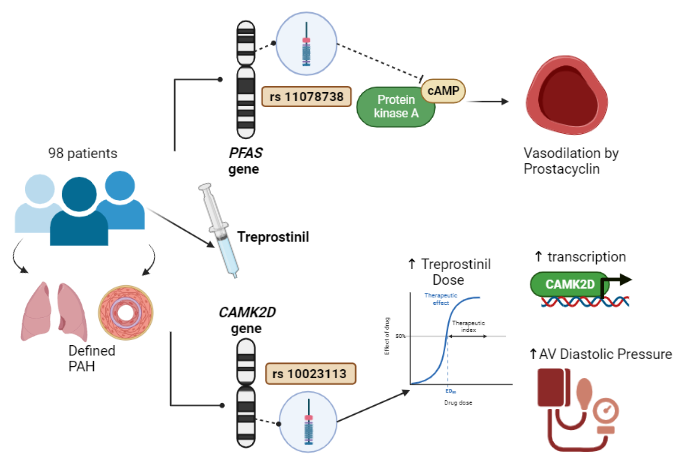
Although with different dosing requirements and varied clinical responses, prostacyclin as an infusion, still is an effective treatment for pulmonary arterial hypertension (PAH). Thomeas-McEwing and colleagues described novel biological markers that can aid in predicting the heterogenicity in response to prostacyclin treatment. They recruited 98 patients from two academic medical centers with hemodynamically defined PAH. Their findings suggest the involvement of two main loci, rs11078738 in phosphoribosylformylglycinamidine synthase (PFAS) gene and rs10023113 SNPs in calcium/calmodulin-dependent protein kinase type II subunit delta (CAMK2D) gene. Cyclic AMP production, which serves as the primary mediator of vasodilation stimulated by prostacyclin was inhibited by the missense variant rs11078738 (p.L621P) in cell lines. A higher treprostinil dose along with enhanced ventricular transcription of CAMK2D demonstrated an association with of rs10023113 variant. Increased right mean atrial and ventricular diastolic pressures showed an association with the same allele as mentioned above during the initial diagnostic catheterization in a separate cohort of patients. The authors argue in their manuscript that these two gene loci exhibit an association with pharmacodynamic response and right ventricular function in PAH to the treprostinil dose. Pharmacogenet Genomics. 2022 Jun 1;32(4):144-151
Downloads
Published
Issue
Section
License
Copyright (c) 2022 Precision Medicine Communications

This work is licensed under a Creative Commons Attribution 4.0 International License.