Genotypic Performance and Assessment of Selection Criteria for Yield and Oil Content in Advanced Lines of Brassica juncea
DOI:
https://doi.org/10.55627/pbiotech.004.01.1832Keywords:
Advance breeding lines, Cluster analysis, Multivariate analysis, Mustard, Oil contents, Principal component analysis, Seed yield, Selection criteriaAbstract
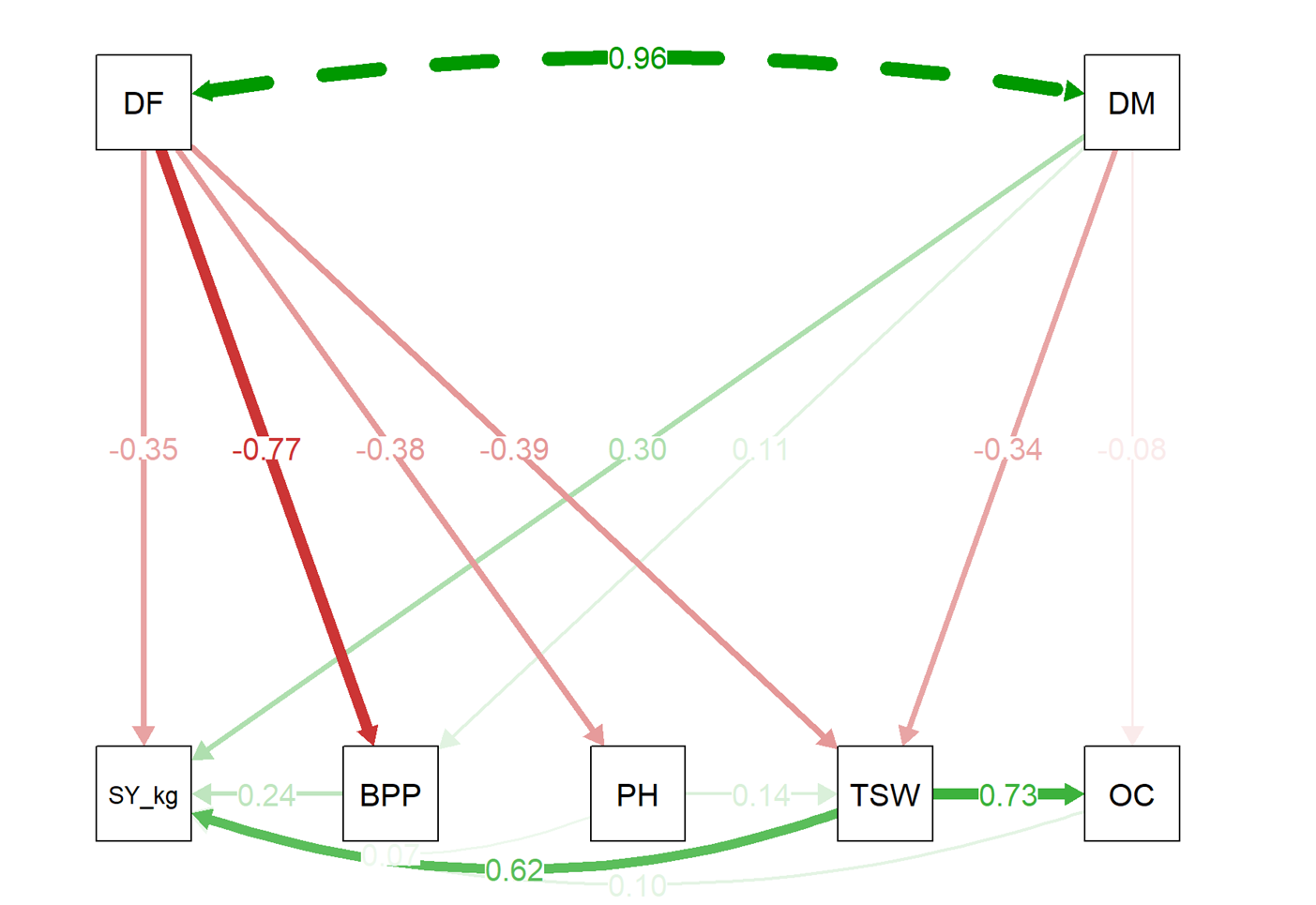
The current study was undertaken to assess genotypic performance and to develop a reliable criterion for the selection of improved seed yield and oil quality in advanced lines of mustard (Brassica juncea L.). Fourteen advanced breeding lines and a commercial check were evaluated in a field experiment using a randomized complete block design with three replications. Various phenological parameters, yield components, and oil quality parameters such as oil content, oleic acid and saturated fatty acids were measured and analyzed using analysis of variance, correlation, path analysis, principal component (PCA), cluster and path coefficient analysis to understand the relationships among the characters and genetic divergence. Among all genotypes, L13 (BR-13) performed better than all others, followed by L9 (BR-9) and L8 (BR-8), while L2 (BR-2) and L5 (BR5) were the poorest-performing genotypes. Thus, the current study revealed that the genotype L13 (BR-13) is the most promising line with early flowering, high seed yield, high oil content, high oleic acid and low saturated fatty acids. Seed yield was found to be significantly and positively associated with number of branches per plant, thousand seed weight, oil content and oleic acid, while saturated fatty acids were found to be negatively associated with yield and oil quality characters. PCA analysis indicated that the first two components accounted for the largest proportion of total variation, separating the genotypes into distinct groups based on yield-oil quality complexes and phenological characteristics. Cluster analysis grouped the genotypes into distinct classes based on early-flowering, high-yielding oil-rich lines and late-flowering, vegetatively vigorous but oil-inefficient types. Path analysis further confirmed the role of thousand seed weight and number of branches per plant as important indirect contributors to oil content through seed yield. The results provide clear selection criteria and demonstrate the value of integrating multivariate tools for accelerating genetic gains in mustard breeding programs.
Downloads
Published
Issue
Section
License
Copyright (c) 2026 Sabir Hussain, Sundas Shahzad, Misbah Zulfqar, Muhammad Shah Jahan Bukhari, Natasha Kanwal, Asad-ur-Rahman Chaudhary, Muhammad Imran Akram, Muhammad Imran, Mahreen Khalid, Hafiz Muhammad Zia Ullah Ghazali (Author)

This work is licensed under a Creative Commons Attribution 4.0 International License.