Harnessing Multi-Scale Phenotyping for Lodging Resistant Wheat: Integrating Traditional and High-Throughput Phenotyping Approaches
DOI:
https://doi.org/10.55627/pbiotech.003.03.1379Keywords:
High-throughput phenotyping, HTP, Lodging resistance, Multi-scale analysis,, Phenotypic integration, Wheat improvementAbstract
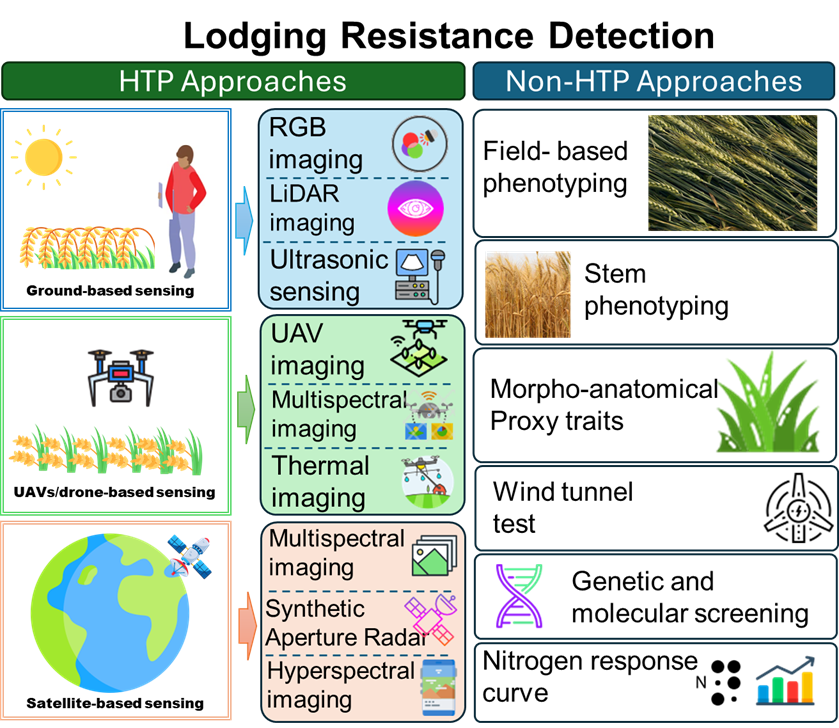
Lodging in wheat is rising globally due to climate extremes, causing yield losses of up to 80% based on timing and severity. Lodging poses a major constraint to wheat production in Pakistan, especially in high-input Punjab and Sindh, with climate variability and unseasonal storms causing yield losses up to 40%. Ground-based, aerial, and satellite-based sensing techniques are vital to high-throughput phenotyping for detecting wheat lodging. Ground platforms using RGB (red, green, blue), LiDAR (light detection and ranging), and ultrasonic sensors enable precise measurement of canopy structure. UAV (Unmanned Aerial Vehicle) based imaging enhances coverage and uses RGB, multispectral, and thermal sensors to detect lodging via visual, spectral, and temperature cues, with RGB approaches exceeding 90% classification accuracy. Satellite imaging enables scalable monitoring of lodging through multispectral indices for early stress detection. Combined multi-scale sensing approaches enhance lodging detection efficiency and accuracy in wheat. Each method offers specific advantages and limitations. Field-based phenotyping is cost-effective under natural conditions but lacks scalability. Stem phenotyping provides direct insights into structural strength but is labor-intensive. Simple morphological traits like plant height and internode length indicate lodging risk but are environment sensitive. Wind tunnel testing offers controlled, repeatable evaluations but requires expensive infrastructure. Genetic and molecular screening allows precise, high-throughput selection, while nitrogen response curves link agronomic practices with lodging susceptibility. Together, these methods enhance wheat breeding for lodging resistance. This review systematically integrates and evaluates existing lodging detection approaches and technologies, drawing cross-study insights into their effectiveness and adaptability for improving wheat resilience under current and anticipated climate stresses
References
Downloads
Published
Issue
Section
License
Copyright (c) 2025 Muhammad Zulkiffal, Javed Ahmed, Sajid ur Rehman, Saira Mehboob, Majid Nadeem, Aneela Ahsan, Sadia Ajmal, Muhammad Hammad Tanveer, Muhammad Owais, Muhammad Makky Javaid, Razia Sultana (Author)

This work is licensed under a Creative Commons Attribution 4.0 International License.