Next-Generation Strategies for Developing and Commercializing Rust-Resistant Wheat through High-Throughput Phenotyping and Genomic Innovations
DOI:
https://doi.org/10.55627/pbiotech.003.04.1709Keywords:
Artificial intelligence, Computer Vision, Multi-omics, Machine Learning, Plant stress, Precision agriculture, Rust resistance, Smart agricultureAbstract
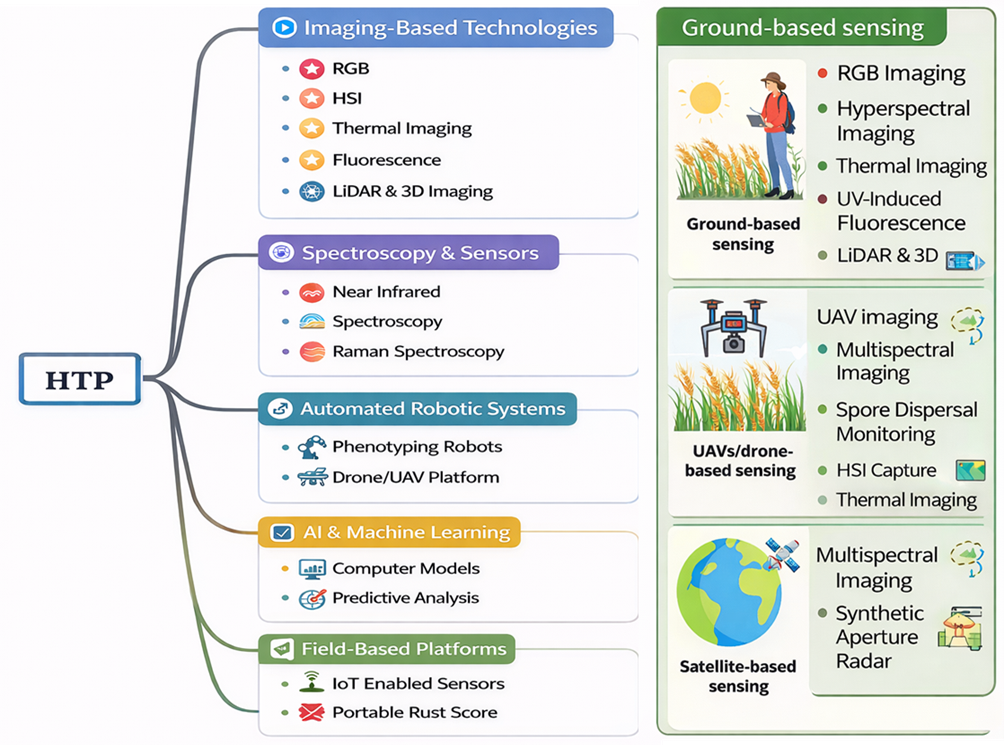
Wheat rusts are the most important diseases leading to substantial yield losses. Early and precise detection of wheat rusts for early mitigation and disease control is imperative. This review summarizes the advances in high-throughput phenotyping (HTP) approaches for rust detection. Additionally, various genomic interventions leading to the development of rust resistance in wheat are discussed in detail. High-throughput phenotyping (HTP) approaches enable early, non-destructive, and repeatable detection of wheat diseases. However, they need initial investment, expertise, and computational resources. RGB imaging achieves ~80% accuracy by capturing infected leaf coloration, while hyperspectral and fluorescence imaging can predict rust with over 90% accuracy, 3–8 days before visible symptoms. LiDAR, UAVs, and robotic platforms automate large-scale field phenotyping, and spectral indices (NDVI, PRI), thermal, and chlorophyll sensors detect early physiological changes. AI and machine learning models, including CNNs and SVMs, enhance diagnostic precision and reduce bias, while mobile apps, lateral flow devices, and IoT-based systems facilitate affordable, real-time rust detection and forecasting. Genomic interventions complement phenotyping, with marker-assisted selection (MAS) enabling precise tracing of rust resistance genes, and genomic selection (GS) allowing early multi-trait prediction. QTL mapping and GWAS identify major and minor resistance loci, while introgression from wild relatives and MAS reduce linkage drag and introduce novel alleles. Transgenic approaches, RNA interference (RNAi), and CRISPR/Cas9 gene editing enhance resistance through targeted gene modification, and gene pyramiding combines multiple loci for durable protection. Wheat pan-genome resources further support precise trait targeting, and speed breeding integrated with MAS, GS, or gene editing accelerates rust-resistant line development. Efficient seed system pathways ensure rapid dissemination, adoption, and resilience. The development and commercialization of rust-resistant wheat varieties under harsh climatic conditions are crucial for mitigating yield losses, reducing fungicide use, safeguarding farmer livelihoods, and ensuring sustainable food security.
References
Downloads
Published
Issue
Section
License
Copyright (c) 2025 Muhammad Zulkiffal, Aneela Ahsan, Javed Ahmed, Saira Mehboob, Sadia Ajmal, Faisal Hafeez, Muhammad Ilyas Khokhar, Muhammad Umer Farooq, Majid Nadeem, Muhammad Abdullah (Author)

This work is licensed under a Creative Commons Attribution 4.0 International License.