Effects of Basil Leaf Extract Priming on Seed Germination and Seedling Growth of Okra (Abelmoschus esculentus)
DOI:
https://doi.org/10.55627/pbiotech.003.03.1434Keywords:
Okra, Basil leaf extract, seed priming, seed germination, seedling growthAbstract
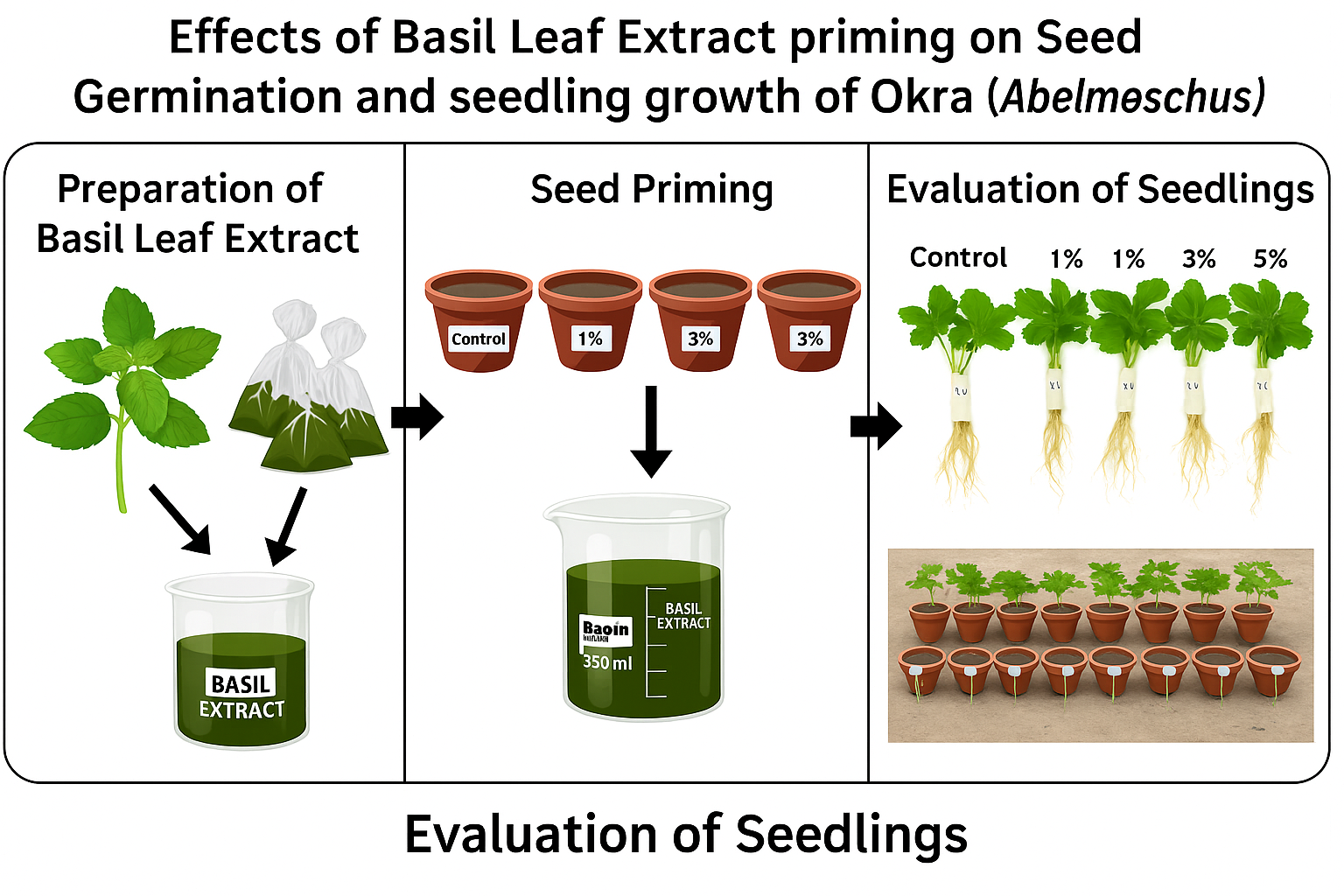
Okra cultivation often faces challenges related to poor seed germination and early seedling growth, necessitating innovative and sustainable solutions. This study was conducted during the spring season of 2024 at the Nursery Department of Horticulture, Sindh Agriculture University, Tandojam, to evaluate the effect of priming with basil (Ocimum basilicum) leaf extract on the seed germination and seedling growth of okra (Abelmoschus esculentus). The experiment was laid out in a completely randomized design (CRD) with two factors: okra varieties (Sabzpari and Crass) and basil leaf extract concentrations (control, tap water, 1%, 3%, 5%, and 7%) with three replications. Data were recorded for seed germination percentage, germination index, seedling vigor index, number of leaves per plant, fresh biomass of root and shoot, root length, plant height and chlorophyll content. The results indicated that basil leaf extract significantly influenced most growth parameters. The highest seed germination (87.50%) was observed with 1% and 3% basil leaf extract, whereas the lowest (70.83%) was recorded with tap water. The Crass variety exhibited a higher germination rate (85.39%) than Sabzpari (77.08%). The germination index was significantly improved by basil leaf extract, with the highest value (0.64) recorded at 3% concentration. Similarly, the seedling vigor index was highest (1290.00) at 3% basil leaf extract, with the Crass variety performing better overall. The number of leaves per plant peaked at 3.66 with 3% basil leaf extract, showing a significant treatment effect. Root and shoot biomass were significantly influenced by basil leaf extract concentrations. The maximum fresh root biomass (0.80 g) and fresh shoot biomass (2.93 g) were observed at 3% basil leaf extract. The highest plant height (39.52 cm) was recorded at 3% basil leaf extract, whereas the lowest (28.74 cm) was observed with tap water (0% basil leaf extract). Chlorophyll content was also significantly affected, with the highest value (42.18) at 3% basil leaf extract and the lowest (30.45) in the control treatment. After going through the findings of present research, it was concluded that the okra verities treated with 3% basil leaf extract showed superior performances in seed germination and growth parameters.
References
Downloads
Published
Issue
Section
License
Copyright (c) 2025 Saeed Ahmed Chachar, Niaz Ahmed Wahocho, Muzafaruddin Chachar, Zaheer Ahmed Chachar, Memoona Islam Majeedano, Sana Shazia Jiskani, Maqsood Ahmed Wagan, Raheem Ullah (Author)

This work is licensed under a Creative Commons Attribution 4.0 International License.