Optimizing Garlic Growth: Influence of Vernalization and Photoperiod on Sprouting and Biomass Accumulation
DOI:
https://doi.org/10.55627/pbiotech.003.04.1497Keywords:
Biomass, Garlic, Growth, Photoperiod, Sprouting, VernalizationAbstract
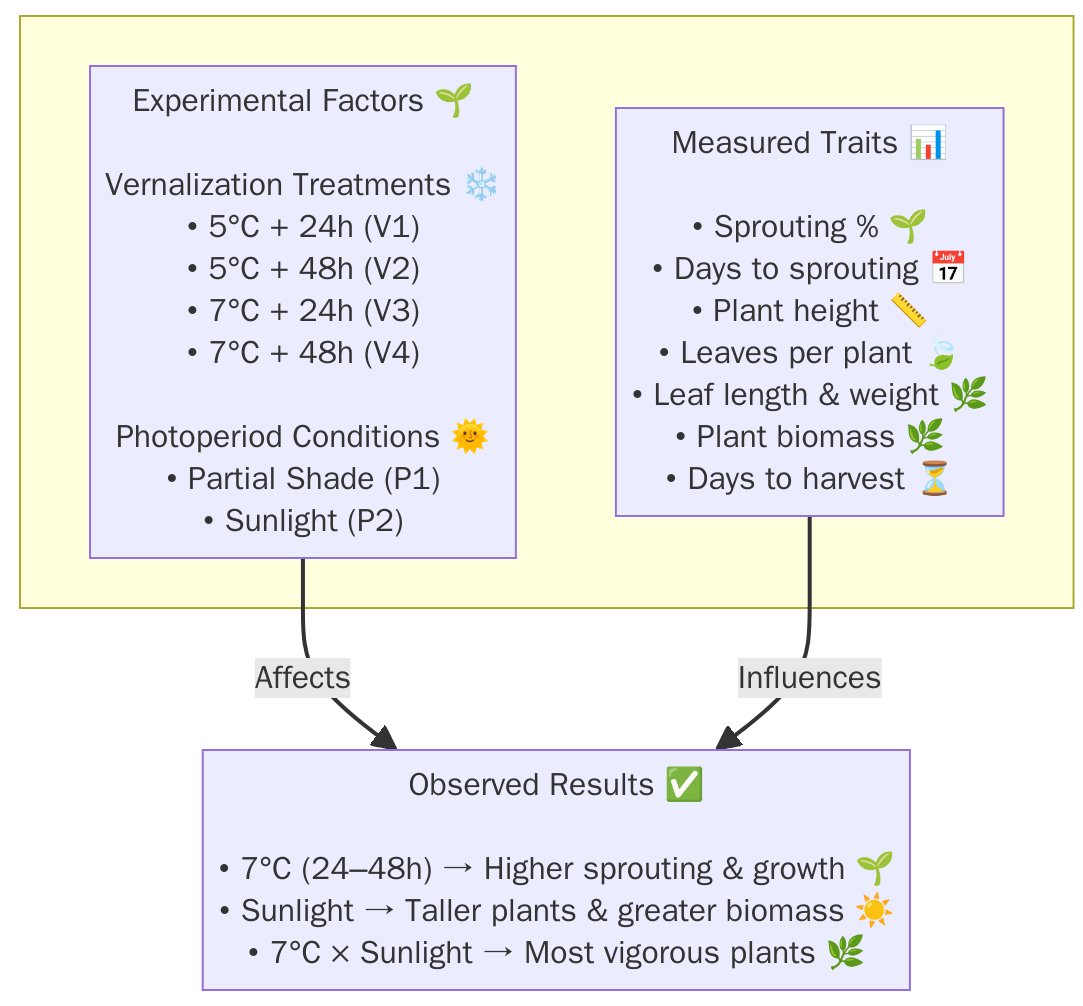
Garlic (Allium sativum) production is often constrained by poor sprouting and weak vegetative growth, which are strongly influenced by environmental cues such as temperature and day length. The present experiment was conducted during autumn 2022-23 at the Nursery, Department of Horticulture, Sindh Agriculture University Tandojam, to evaluate the effect of vernalization and photoperiod on the sprouting and early growth of garlic variety Desi at the green stage. The experiment followed a Completely Randomized Design (CRD) with a factorial arrangement comprising vernalization treatments (V1 = 5 °C + 24 h, V2 = 5 °C + 48 h, V3 = 7 °C + 24 h and V4 = 7 °C + 48 h) and photoperiods (P1 = Partial shade and P2 = Sunlight). Data were recorded for sprouting percentage, days to sprouting, plant height, leaves per plant, leaf length, leaf weight, fresh biomass, and days to harvest. Vernalization and photoperiod significantly influenced most growth attributes. Cloves treated at 7 °C for 24 h or 48 h generally showed improved performance across sprouting and vegetative parameters. Specifically, 7 °C for 24 h promoted early sprouting and higher leaf weight, while 7 °C for 48 h produced longer leaves and greater fresh biomass. Plants grown under sunlight exhibited superior plant height and biomass compared to partial shade. The interaction of 7 °C treatments with sunlight yielded the most vigorous plants overall. In conclusion, short- to moderate-duration vernalization (7 °C for 24-48 h) significantly enhanced sprouting and vegetative growth of garlic, with photoperiod playing a decisive role in optimizing these responses.
Downloads
Published
Issue
Section
License
Copyright (c) 2025 Maira Raqeeb Tunio, Tanveer Fatima Miano, Muzafaruddin Chachar, Ghulam Fatima Tunio, Aaqib Mustafa, Ghulam Rasool Tunio, Shahmeer Khan Tunio, Memoona Islam Majeedano, Sana Shazia Jiskani (Author)

This work is licensed under a Creative Commons Attribution 4.0 International License.