Exploring Genetic Diversity for Yield Improvement in Pea (Pisum sativum L.) Genotypes using Multivariate Analysis
DOI:
https://doi.org/10.55627/pbiotech.003.04.1585Keywords:
Cluster analysis, Genetic diversity, Multivariate analysis, Pisum sativum, Principal component analysis, YieldAbstract
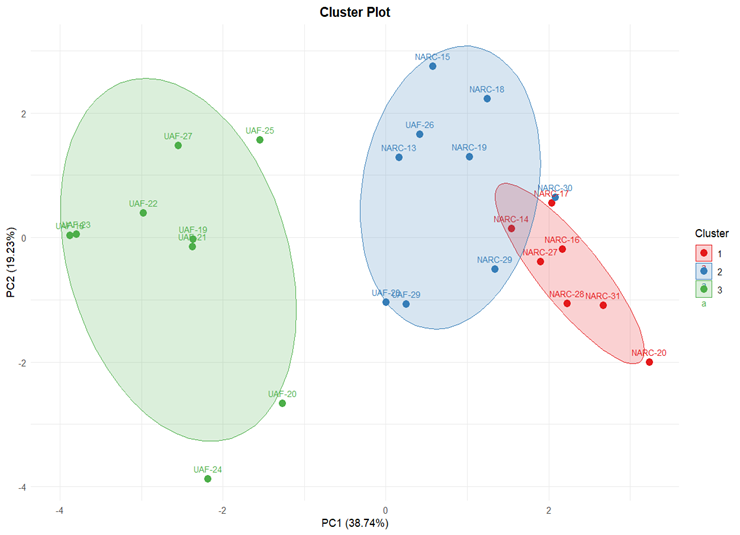
Genetic variability can play an essential role in the pea breeding strategies to develop new varieties of peas with enhanced yield. This study evaluates 12 traits in 25 diverse genotypes of peas which include NARC and UAF genotypes. All the studied characters showed high to moderate values for both genotypic and phenotypic coefficients of variance along with significant heritability and genetic advance except for number of secondary branches and plant height at first flower. For all the characters studied, values for PCV were generally greater than the GCV values. While principal component analysis studies clarified that a total of 81.41% of variation was exhibited by first four components among the genotypes having the eigenvalues higher than 1. Further, K-means cluster analysis, based on cluster biplot between PC1 and PC2, classifies the 25 cultivars into three separate clusters. Overall genotypes present in Cluster I acquired higher mean values compared to Clusters II and III. Cluster I was grouped by seven accessions and other two clusters were grouped with 9 genotypes each. Highest mean values were exhibited by yield per plant (47.74), number of pods (155.94), plant height at maturity (246.43), number of nodes (83.33) and number of effective pods (135.36) for genotypes in Cluster I. For genotypes in Cluster II, plant height at first flower (54.53), number of primary branches (11.17), and 100 seed weight (19.35) revealed maximum means. While high mean values were shown by number of secondary branches (21.23), pod length (6.88) and seed per pods (5.93) in Cluster III. Genotypes from the cluster I performed better which may contribute to the future breeding programs.
Downloads
Published
Issue
Section
License
Copyright (c) 2025 Muhammad Shoaib, Amir Shakeel, Mudassar Iqbal, Muhammad Rizwan Shafiq (Author)

This work is licensed under a Creative Commons Attribution 4.0 International License.