Role of AI and Big Data for Managing Plant Stress in Smart Agriculture
DOI:
https://doi.org/10.55627/pbiotech.003.04.1702Keywords:
Artificial intelligence, Computer Vision, Multi-omics, Machine Learning, Plant stress, Precision agriculture, Smart agricultureAbstract
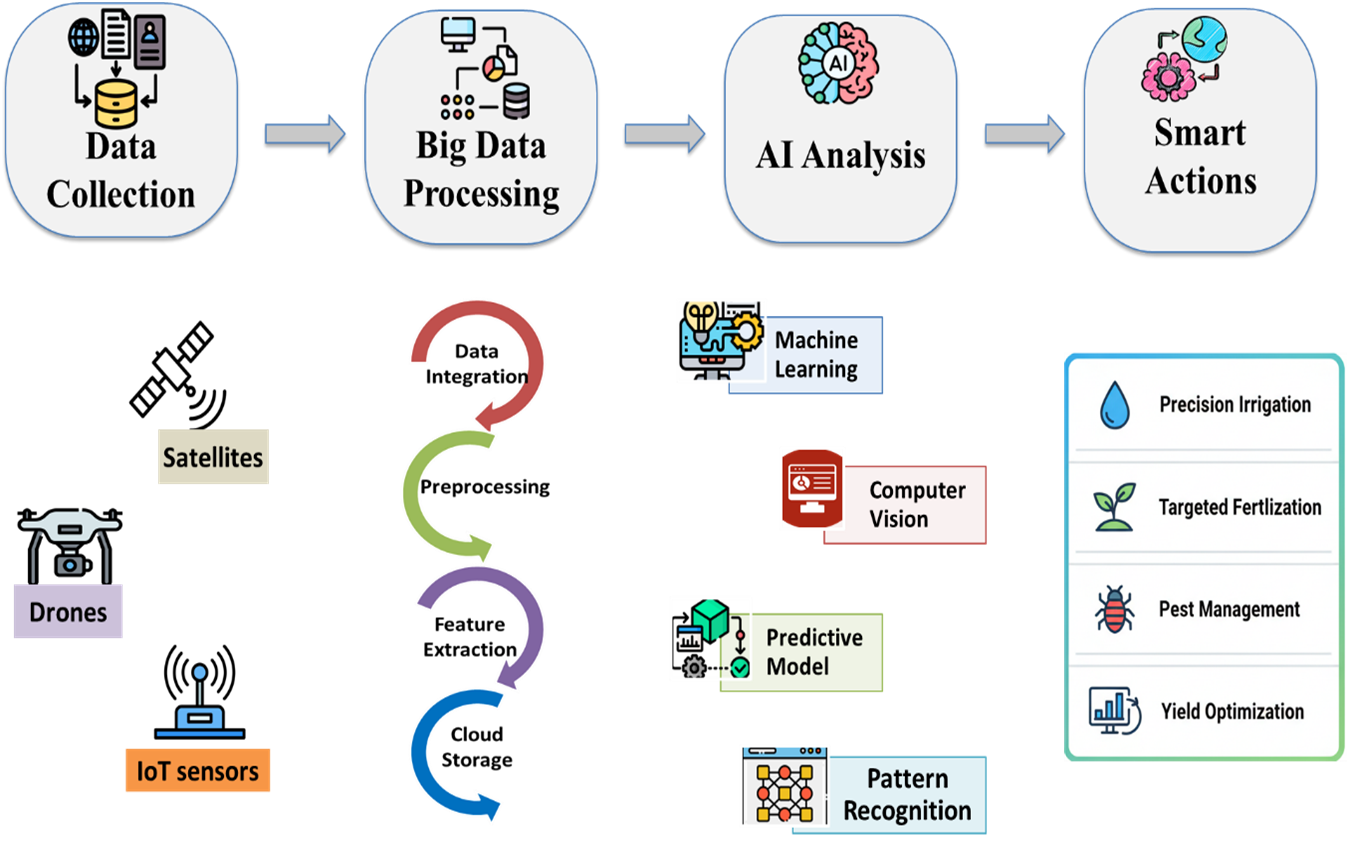
Artificial intelligence (AI) and big data have greatly transformed plant stress management practices in smart agriculture. Conventional stress management approaches have many limitations regarding precision, efficiency, and scalability, which are being resolved using modern digital technologies. Machine learning (ML) and deep learning are advanced AI techniques that can easily analyze diverse data from images, sensors, and multi-omics. These assist in early stress identification, classification, and prediction of future risks associated with stress. ML models (both supervised and unsupervised) have the ability to accurately classify the stress types. Computer vision technology is widely used in agriculture and helps in conducting timely decisions by detecting morphological and spectral alterations in plants. Big data facilitates unraveling complex mechanisms underlying plant stress through integrative multi-omics. Various AI-driven predictive models have also been applied in forecasting insect pests and disease outbreaks. Furthermore, AI and big data are revolutionizing agriculture through precision fertilization and irrigation, robotic spraying technology and AI-integrated farm management information systems. Thus, AI and big data have significantly advanced conventional methods in plant stress management.
Downloads
Published
Issue
Section
License
Copyright (c) 2025 Warda Ghaffar, Qalb e Abbas Qaseem, Ghulam Mustafa, Muhammad Sarwar Khan, Rimsha Riaz (Author)

This work is licensed under a Creative Commons Attribution 4.0 International License.