Line × Tester–Driven Assessment of Genetic Variability, Parental Contribution, and Hybrid Response for Yield Improvement in Bitter Gourd (Momordica charantia L.)
DOI:
https://doi.org/10.55627/pbiotech.004.01.1781Keywords:
Bitter gourd, Line × tester analysis, Genetic variability, Combining ability (GCA and SCA), Heterosis, Hybrid breeding, Yield improvementAbstract
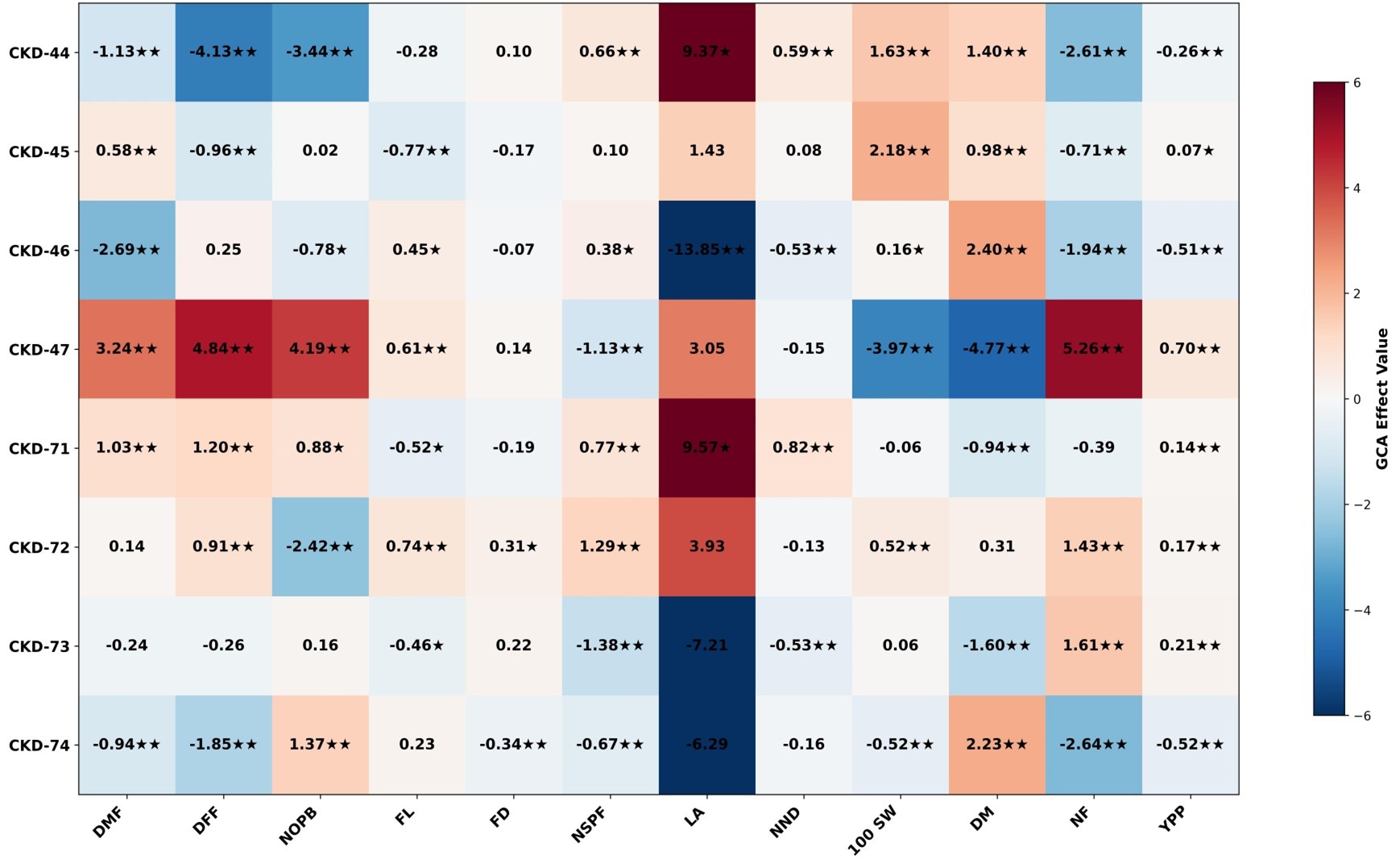
Bitter gourd (Momordica charantia L.) is an economically important cucurbit in Pakistan, yet its productivity remains low due to limited availability of genetically improved hybrids. This study assessed genetic variability, combining ability, and heterosis in sixteen F₁ hybrids developed through line × tester mating design by crossing four female inbred lines (CKD-44, CKD-45, CKD-46, CKD-47) with four designated male testers (CKD-71, CKD-72, CKD-73, CKD-74). Significant differences among parents, hybrids, and line × tester interactions for all morphological and yield-related traits confirm substantial genetic variability. Highly heritable traits coupled with moderate to high genetic advance such as days to male and female flowering, number of primary branches, seeds per fruit, 100-seed weight, and yield per plant indicated the involvement of both additive and non-additive gene actions. Lines CKD-47, CKD-44, and CKD-46 exhibited superior general combining ability (GCA), while testers CKD-71, CKD-74, and CKD-73 also demonstrated favorable GCA for earliness and yield traits. The hybrids CKD-4572, CKD-4574, and CKD-4771 showed the highest specific combining ability (SCA), particularly for days to female flowering, primary branches, and days to maturity. Strong positive SCA effects in hybrids CKD-4474, CKD-4573, CKD-4671, and CKD-4774 translated into significant yield enhancement. Remarkable heterosis was observed in CKD-4473, CKD-4573, and CKD-4772, with yield heterosis peaking in CKD-4772 (90.91%) and CKD-4773 (93.94%), highlighting their commercial potential. Overall, both additive and non-additive genetic effects govern key traits. The parents CKD-44, CKD-46, CKD-47, CKD-71, CKD-73, and CKD-74, along with promising hybrids CKD-4474, CKD-4573, CKD-4671, and CKD-4774, are recommended for future bitter gourd breeding programs and multi-location evaluation.
References
Downloads
Additional Files
Published
Issue
Section
License
Copyright (c) 2026 Ghulam Murtaza, Muhammad Qasim, Muhammad Talal Ahmad, Waqar Ahmad, Sidra Iqbal, Muhammad Rizwan Shafiq (Author)

This work is licensed under a Creative Commons Attribution 4.0 International License.