Eco-Friendly Management of Fusarium Wilt of Pea (Pisum sativum L.) using Biocontrol Agents
DOI:
https://doi.org/10.55627/pbiotech.004.01.1872Keywords:
Bacillus subtilis, Biological disease management, Dual culture assay, Fusarium oxysporum, Janthinobacterium lividum, Pea wiltAbstract
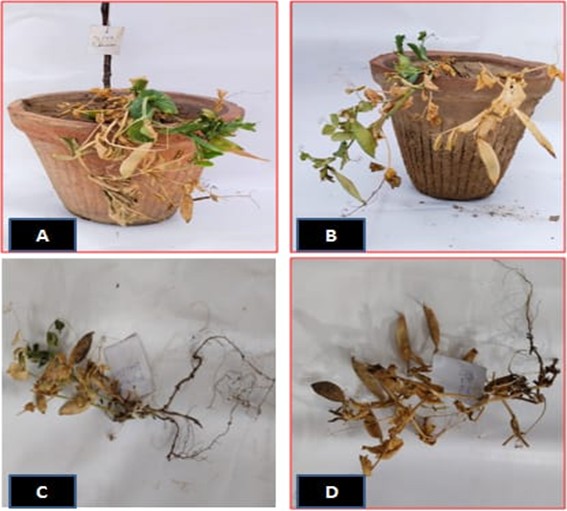
Pea (Pisum sativum L.), a vital leguminous crop, is severely affected by Fusarium wilt caused by Fusarium oxysporum f. sp. pisi. In the current study, we tested the effectiveness of biocontrol agents under in vitro and pot conditions. The pathogen was isolated from infected plants collected from Faisalabad. The pathogen was identified based on morphological features. Four biocontrol agents were tested using a dual culture technique under in vitro conditions: Bacillus subtilis, Janthinobacterium lividum, Beauveria bassiana, and Verticillium lecanii. The biocontrol agents were further tested using a seed priming technique on three varieties of peas: Sarsabz, Mateor, and Pea-2009. Results showed that J. lividum exhibited maximum inhibitory activity (31.97%) at 12 days of incubation, however, B. subtilis consistently showed antagonistic activity (24.80%). In pot experiments, B. subtilis significantly reduced disease incidence and severity in all varieties as compared to controls. In addition, B. subtilis significantly improved growth parameters in comparison to controls under pot conditions. Among the varieties, Sarsabz showed better results. It can be concluded that B. subtilis showed promising potential for the management of Fusarium wilt of pea under controlled conditions, however, further validation under field conditions and molecular-level investigations are required.
References
Downloads
Published
Issue
Section
License
Copyright (c) 2026 Abdul Rahman, Muhammad Usman, Numaad Ihsan, Muhammad Talha Ashraf, Ayesha Khalid, Muhammad Ehetisham-Ul-Haq, Huma Abbas, Amjad Abbas (Author)

This work is licensed under a Creative Commons Attribution 4.0 International License.