Genome-wide Identification and Expression Analysis of ERF (Ethylene Response Factor) Gene Family in Beta vulgaris under Salt Stress
DOI:
https://doi.org/10.55627/pbiotech.003.04.1458Keywords:
Beta vulgaris, ERF gene family, Expression analysis, Phylogenetic, Salt stressAbstract
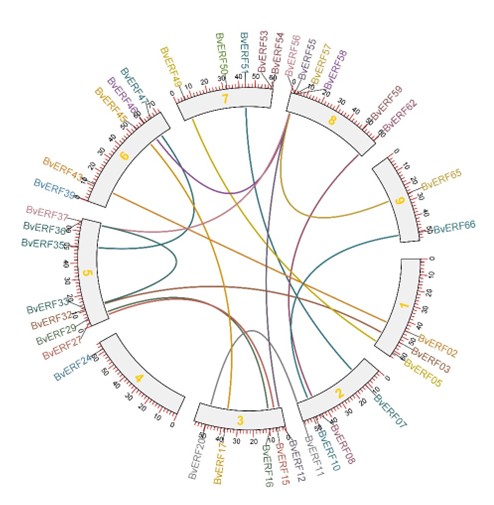
The ERF (ethylene response factor) gene family constitutes one of the most significant families of transcription factors present in plants. These factors play a pivotal role in regulating various biological and physiological responses, including development, plant growth, and biotic and abiotic stresses. In order to explore the characteristics of sugar beet (Beta vulgaris L.), a series of analyses were employed. These included genome-wide identification, gene structure, phylogenetic, and promoter analysis of the ERFs. The objective of these analyses was to predict the potential functions of the ERFs. Among the 73 genes examined, 67 were identified as non-redundant, and the chromosomal distribution pattern revealed that all genes were mapped across nine different chromosomes. A subsequent analysis of conserved motifs identified ten distinct motifs, with BvERF07 and BvERF51 demonstrating the least motif complexity. A subsequent analysis, employing a phylogenetic approach and comparing the genes with those of A. thaliana, resulted in the delineation of nine distinct clades. This finding indicates not only functional conservation but also divergence over time. A thorough examination of the promoter sequence revealed the presence of a multitude of cis-regulatory elements, which have been associated with stress and hormonal responses. Synteny and gene duplication analyses further supported the evolutionary conservation of the ERF gene family. Transcriptomic profiling under salt stress revealed several differentially expressed genes, notably BvERF02, BvERF50, and BvERF34, indicating their potential involvement in salinity tolerance. This study presents foundational visions into the structure, evolution, and stress-responsive roles of BvERFs, offering candidate genes for genetic improvement of salt tolerance in sugar beet.
References
Downloads
Published
Versions
- 2025-11-13 (2)
- 2025-11-10 (1)
Issue
Section
License
Copyright (c) 2025 Muhammad Anas, Muhammad Luqman Aleem, Ayesha Khalid, Muhammad Qasif Naeem, Muhammad Awais, Muhammad Imtiaz, Muhammad Zahid Ramzan, Mahad-ur-Rehman (Author)

This work is licensed under a Creative Commons Attribution 4.0 International License.